May 6, 2026

Pre-construction
Small Teams, Big Expectations: Scaling Pre-construction Without Burning Out Staff
Pre-construction teams are being asked to do more with less. Here's why the pressure keeps growing — and what leading GCs are doing about it.
Pre-construction sets the parameters of every project that follows. Get it right and you're building on solid ground. Get it wrong and every downstream phase pays the price — in cost overruns, schedule delays, and compliance problems that surface at the worst possible time. So why do so many general contractors rush through it?
The answer isn't carelessness. It's capacity. Pre-construction teams are being squeezed from every direction — shorter timelines, more RFPs, fewer people, and growing compliance requirements that didn't exist a decade ago. The work keeps expanding. The teams don't.
Pre-construction: the most consequential phase
Before a single crew mobilizes, the pre-construction team has already made decisions that will shape the entire project. Scope definition, constructability review, value engineering, site assessment, cost estimation, scheduling, permitting coordination, designer alignment, and subcontractor solicitation — all of it happens before construction begins, and all of it carries forward.
What GCs are responsible for in pre-construction
- Clearly define project scope and constructability
- Perform value engineering to identify cost-saving alternatives
- Assess the construction site for potential issues
- Develop cost estimates and construction schedules
- Assist with permitting and approvals
- Coordinate with designers and owners
- Solicit bids from subcontractors, including certified and small firms
Subcontractors carry their own pre-construction burden as well — scope reviews, conflict identification, labor and materials estimates, and schedule development. The phase is demanding on all sides.
And yet the time allocated to it rarely reflects its importance.
The time problem: why teams rush
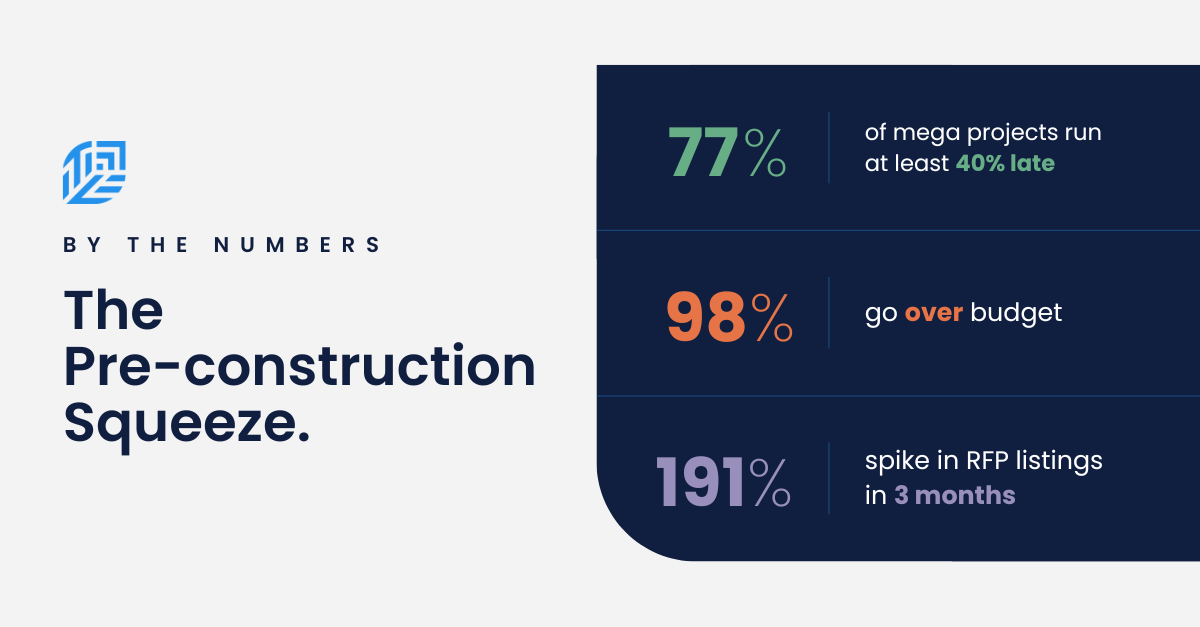
Construction projects finishing late is so common it barely registers as news. McKinsey found that 77% of mega projects finish at least 40% late — and 98% go over budget. But the same study makes clear that many of those outcomes were baked in long before construction started.
77%
of mega projects finish at least 40% late
98%
of mega projects go over budget
65%
average cost overrun across 16,000+ projects studied
The pressure starts at the RFP. Project owners set submission deadlines and hold to them regardless of what's happening on the GC side. The average time GCs get to complete an RFP is 1–2 weeks. That's not much runway for a process that involves scope analysis, certified subcontractor outreach, participation goal documentation, and bid assembly — especially when a recent survey found that more than 82% of new business comes through RFPs.
The math doesn't work. Teams are given 1–2 weeks to complete a process that, done properly, requires far more. Something gets cut — and it's usually the outreach, documentation, and compliance work that causes the most pain later.
The result: teams submit fewer bids than they should, or rush the ones they do submit, setting up projects for downstream problems before the first shovel breaks ground.
A shrinking workforce, a growing workload
The construction labor shortage is well-documented on the field side. Less discussed is how far it extends into back-office roles. Construction Dive put it plainly: many estimators today are effectively doing the work of two or three people.
Meanwhile, the workload is growing in every direction. RFPs are getting longer and more detailed. Between November 2025 and January 2026, construction-related RFP listings skyrocketed by 191% — climbing from 74 to 215 monthly listings. More bids, more requirements, fewer people to handle them.
The squeeze is direct: teams submit fewer RFPs, or dedicate less time and detail to the ones they do complete. Either way, they win fewer jobs. And the jobs they do win aren't set up for success, because a rushed pre-construction process creates downstream consequences that compound throughout the project.
"Our estimating department is just two people, so we don't have the resources to make phone calls."
— Dan Pierce, Senior Estimator, L.S. BrinkerSubcontractor outreach is one of the most time-consuming tasks in pre-construction — and one of the least technical. Reaching out to certified firms, confirming qualifications, and encouraging them to bid takes hours that most estimators simply don't have. It's the kind of work that benefits from dedicated capacity, which is exactly what lean teams lack.
How GCs are solving it
Dan Pierce turned to Tough Leaf when L.S. Brinker's two-person estimating team hit their limit. "Tough Leaf jumped in and immediately began going through the list, calling all the trades, and confirming who's bidding and who's not bidding," he said — and the outreach got certified subs excited to participate.
Pierce estimates Tough Leaf saved him 240 hours of work he never had to begin with. He had only 80 hours to complete the entire task — and identifying subs was just one piece of his workload.
The solution isn't always the same for every team. Some need the outreach handled entirely. Others need better tools to run it themselves.
ManagedOutreach
For teams that need the work done for them. Tough Leaf's experts source, engage, and vet certified and small subcontractors on your behalf — from trade identification through bid confirmation.
Learn more →ClearSource
For teams that want to run their own outreach with better infrastructure. Find and manage certified subs, verify documentation, and track the full process in one place.
Learn more →Pre-construction will always be demanding. The scope of decisions made in that phase — and the consequences they carry — aren't going to shrink. But the outreach and compliance piece doesn't have to grind your team to a halt. The GCs who are keeping up aren't necessarily bigger. They're just better resourced for the parts of pre-construction that scale poorly on their own.
Tough Leaf
Pre-construction support that fits how your team works.
Whether you need outreach handled end-to-end or better tools to run it yourself, Tough Leaf works the way your team does.
Book a DemoStay Ahead of What’s Happening in Construction
Get monthly insights on sourcing, compliance, participation, and reporting — plus updates on what Tough Leaf is building and learning alongside owners, agencies, and GCs.
Built for Prime Contractors, Government Agencies, and Certified Subcontractors.
.svg)
.svg)
.svg)
.svg)
.svg)